Monday, June 27, 2011

Working on Site


Finally getting around to posting a few images of the process in situ. The beauty of this work is that it seems it can be done just about anywhere. This first image is taken in a national park camping ground on the east coast of Australia and the material i am working with is collected from around the surrounding empty camp sites.


This one is of my sister in law Rita who joined in on the project for a day alongside the Cooks river. We didn't have to walk far that day as there was plenty of material to work with.


I have started to invite people to join me in the process and we meet at their house and trial the project in their neighbourhood.

This the lovely Tiff in a sunny park in Brunswick.


We ended up having some lunch in a Cafe and used garden area as a work space for the afternoon.


Sunday, June 26, 2011

little piles of plastic

Not long after I began Seeding the Cloud i came across these images depicting the skeletal remains of Laysan albatross chicks who fed on a diet of plastic starve to death.(Copyright Chris Jordan images from the series titled Midway: Message from the Gyre2009 http://www.chrisjordan.com/gallery/midway/#CF000313%2018x24) After the soft tissue decomposes the remaining bones and feathers of the chicks frame a pile of ingested plastic fragments. These images were taken at the Marine and Wildlife Park on Midway Atoll, a small land mass in the North Pacific Ocean located in an area where oceans converge known as the North Pacific Gyre or Convergence Zone. Petroleum based plastics are insoluble and create a toxic marine pollutant. Initially they concentrate in the pelagic zone (floating near the surface) and mimic in colour and size wildlife food sources thus undermining the viability of many marine and bird species known to feed in the area. The loss of generations of Albatross is a direct result of human action and inaction – their death primarily a result of poor waste management and a lack of public interest/imagination in establishing counteractive measures. This environmental problem occurs in international waters and current political inaction is a direct result of out of sight out of mind.

When I view these images there is evidence of a collection process that while it occurs at the other end of the moral spectrum in a perverse way reflects something of my own. Obviously there is a differing and more tragic outcome but as I collect and process the fragments of plastic I have a sense of connection to an event or issue that extends well beyond myself.


Thursday, April 14, 2011

step by step

Here's a brief description of the STC working procedure:


I begin by going for a walk – it’s more of an amble, my pace is slow so that I can scan the terrain for fragments of hard plastic.

I wander, along main roads through suburban streets down lane ways, across playgrounds, train lines, car parks and sporting grounds ...

I often take my dog for company, although lately I invited a friend or two to join me.

I carry with me a prepared pack of hand tools – hand drill, scribe, a woodenwedge with a hook attached, G Clamp, a wooden block with screws drilled into the top, silk thread, threading needles, pearlescent plastic beads.


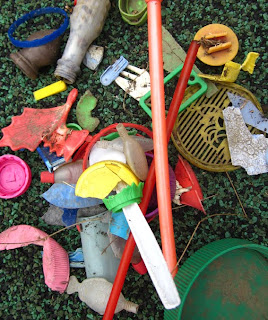
As a wander I collect fragments of hard plastic

Run over chopped up, swept into crevices and corners as they break down fragments tend to evade all mechanical methods of rubbish removal.

The only way to remove them is to pick them up by hand.


I pause at intervals along the way.

Usually at bus stops, park benches or other forms of public architecture. I carry tools to clamp on or wedge in to adapt these spaces as a temporary workstation.


I sort, drill and thread the found plastic with pearlescent beads. I repeat this process until I have gathered and threaded a necklace length of plastic fragments. The time it takes and the distance I travel is dependent on the amount of material I find.


I repeat the procedure Walking, collecting, drilling and threading. Over time I create a string of beaded fragments.


Upon my return I add it onto an intricately bejeweled looping matrix that can be read or interacted with as a wearable object or as cartographic trace of my engagement with matter, time and site.

Wednesday, April 6, 2011

seeding the clouds


A few years ago I heard Australian of the year Scientist Tim Flannery discuss global warming. He outlined several science-based solutions, one of which involved propelling sulphur particles into the atmosphere creating a protective shield to promote cooling of the planet.

While I admire Flannery's advocacy on climate change the scale of human intervention into the environment he proposed came as a shock to me. While clearly thinking on a global scale the sulphur solution seemed to suggest that Flannery, and by extension science, held no faith in the ability of humanity to work collectively towards solutions for living sustainably on the planet.

Confronted by apocalyptic science and failing political leadership I noted the way solutions are constructed are subject to our field of expertise or power base. I was compelled to think through my own area of practice and began to explore the conceptual, material and social potential of jewellery as a structure through which to invite public engagement with the larger issues of our time. Its idealistic I know, but why should the scientists get all the fun!

Seeding the Cloud: A Walking Work in Process is a project I have been developing over the last 12 months. The design of the project was drawn from my experience of creating interactive/performative works that reflected upon the symbolic language of jewellery and making wearable objects from discarded material collected from the urban environment.

The work is initiated in walking, and the experience is deepened through observing, collecting and processing residual fragments of hard plastic. Initially performed as a solo work I have begun to develop its potential as a civic work that can be taken up by individuals or small groups anywhere/anytime in neighbourhoods around the world. My hope is that with time the project will help us to recalibrate an understanding of the individual vs public need, waste matter vs resource material, land value vs habitat etc

My intention with this blog is to document the project, it may appear as if it proceeds with a linear momentum but this has more to do with my inability in HTML design. Hopefully it will unravel as a series of ideas and experiences, wanderings that first occured and held meaning in my neighbourhood and hopefully continue in the direction where they are taken up and engaged with in yours.

Please comment and contact me if you are interested in participating.


image credit: http://en.wikipedia.org/wiki/Tim_Flannery